Tuesday, September 11, 2012

Alpha Utara Exhibition


 Dato' Gary Thanasan, CEO Mediate Communications launching the opening of the exhibition at Al;pha Utara Gallery.
Mediate Communications, founded by Dato' Gary Thanasan, began its operations in 1998, offering professional public relations services to a diverse range of clientele. Over the years we have maintained a focused approach to media relations and have developed key tools to enable us to deliver professional services.

Mediate Communications offers an Integrated Communications Service, where our clients can choose to use us for one service or for a combination of services on a project or a retainer basis. Our aim is to be flexible and responsive to a client's changing needs. What we also realize is the importance of being networked, so we have a number of strategic alliances that we have forged with specialists in different fields that complement our marketing skills.
So what do you think of this show Cecil? Its great! We got a potential new  buyer in town, you know we need it badly here, no one is buying art anymore, how are artist going to live? Most of these pieces are from the old well established artist and everywhere you go you see them selling the same works by the same artists like this country has no other good artist deserving an equal exposure!
One shot for posterity my friends. 
Ricardo; I think most of these works are more Western than local. Very few truly express the local themes.
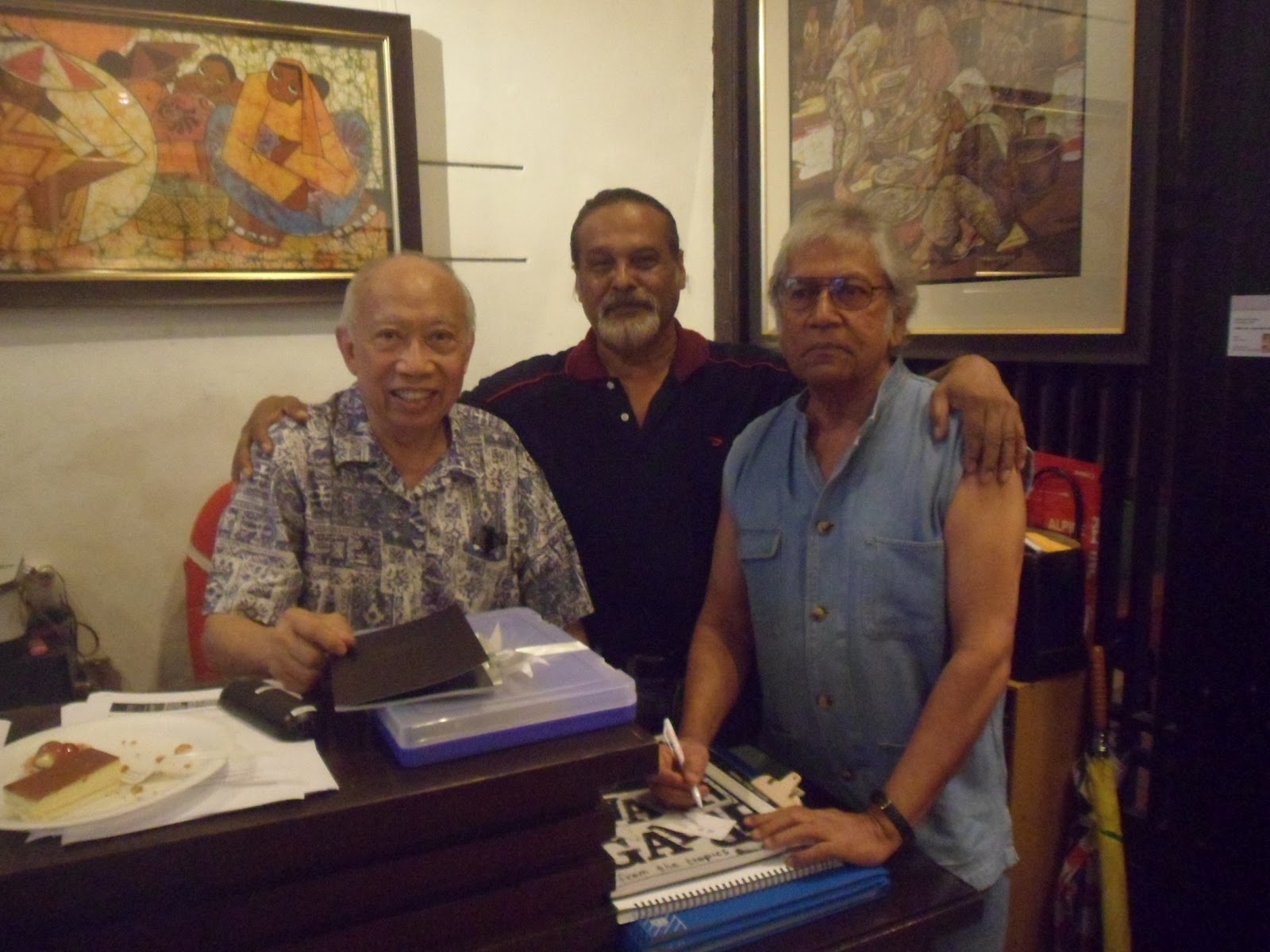
Sui Hoe, Bahari,, Ricardo, and Leekhai.
Dato'Thanasan and Dato' and Datin Dr. Tan
Local scene on my right and Global scene on my left.
The regulars at Alpha with Dato'Thanasan.

A Borrowed Article Worth Reading


How Giving Changes Everything

Article by Zen Habits contributor Jonathan Mead.
We often think that our success depends on focusing on ourselves. But this simply isn’t true.
Every successful person knows that you become successful because of how much value you give to others.
Yet, we often forget this.
It works the same way with our happiness, too. When I become overly focused on my goals and my feelings and my desires, I start to feel down. When I become focused on myself, it’s easy to think that everything is about me. But it’s not. And when I’m so focused on myself, I start to become easily offended by others. I think that others do things that I don’t like because of me, when they’re really just doing those things because of themselves.
See how easy it is to become depressed when you feel overly self-important?
That’s why it helps to turn your attention to others, and put your focus on giving, rather than receiving. You would think that by giving all the time, you will never receive. But the exact opposite is true; it’s because you give so much that you attract the desire for others to give back to you.
It’s crazy how this works:
  • The best way to be interesting is to be interested in others.
  • You gain more physical energy by burning energy when you exercise.
  • The way to be loved is to be lovable.
  • When you seek to understand, others are more likely to want to understand you back.
  • By helping others, they are more inclined to help you in return.
I think it’s interesting how we intuitively know these things, but somehow our ego gets in the way. Our self-importance makes us think that we need to receive to justify giving. This is the same part of you that seeks to be right instead of happy. Is it worth it?
I think it’s a much more empowering position to be the one that gives first. Otherwise, who knows how long it will take the other person to initiate, if it even happens at all. To wait for others to give is like waiting for someone to give you what you want. Why not just ask and find out what happens?
Giving yourself away.
When you can give without expecting anything in return, you have mastered the art of living.
Is it any wonder that the most successful people in the world are masters of giving? The most successful people are the ones that provide the most value to others.
So the question is: How can you give more of yourself away?
I think you’ll find, as I have, that you’re most fulfilled not when you’ve done something really cool, or when you’re doing something that excites you (not that those things aren’t important). You are most fulfilled when you’re serving others.
Here are some suggestions for small, but powerful ways you can give to those around you today:
  • Drop the expectations that you have for your partner and your family. Instead of expecting them to behave a certain way to you, see how you can show them how much they really mean to you.
  • Give away your attitude. This is really one of the most awesome ways you can give to others. Your attitude and positive energy has an amazing effect on those around you. Darkness, when approached with light, becomes illuminated. In the same way, low energy, when approached by higher energy, dissolves. Help dissolve others’ lower energy patterns by bringing your higher, positive energy to them.
  • Gift your intention. Whenever you encounter someone, say a silent blessing or send them a positive intention, instead of judging them.
  • Show your gratitude. Write a simple note or letter expressing to someone how much they mean to you and the reasons you love them. The impact this will have on the receiver is amazing.
  • Simply offer your help. If there’s nothing specific you can do for another person, simply let them know that if there is ever a way you can help, you would like them to let you know.
These things may seem small, but I think the world is changed by a profusion of micro ideas. Revolutions start with small actions.
So what I’d like to ask you now is, How can I help you? Let me know!
This article was written by Zen Habits contributor Jonathan Mead of Illuminated Mind.


On Racial Prejudice 4

Now that I have a rough sketch of my family tree; where my grand parents originated from and so my parents, where do I fit in in the so much bragged about multi-racial society of Malaysia? Am I a Malay? depending on who I ask I will get a different answer; a Chinese would not have the same a  Malay or an Indian  as each would look at me from their own racial and religious make up with a touch of social political implications added to suit their own national self interest. My children will have steeper hill to climb and I hope by the time they are forced to make a stand in the interest of the country they will stand up and safely claim,   " I am a true Malaysian!"; I am not Malay, Chinese or Indian, I represent all of the above and then some. Our father was born and raised in this country they can claim and that makes us Malaysians.
Needless to say but say I must, I am a proud Malaysian who had turned down an offer to become an American citizen by the then Asst. Director of the Chicago Department of Immigration who I met in 1980? and appeared together on a  TV program in Green Bay, Wisconsin.The program was about Apartheid and along with the two of us was an African National Congress member from South Africa.I was invited to be one of the panel members on account of my background as a Malaysian. Perhaps on account of my comments on the air I was later later investigated by the FBI who came to the University and questioned a few of my Instructors and friends. I was given a clean bill of health so they never approached me personally.

"The crime of apartheid is defined by the 2002 Rome Statute of the International Criminal Court as inhumane acts of a character similar to other crimes against humanity "committed in the context of an institutionalized regime of systematic oppression and domination by one racial group over any other racial group or groups and committed with the intention of maintaining that regime." Wikipedia
.On 30 November 1973, the United Nations General Assembly opened for signature and ratification the International Convention on the Suppression and Punishment of the Crime of Apartheid.[1] It defined the crime of apartheid as "inhuman acts committed for the purpose of establishing and maintaining domination by one racial group of persons over any other racial group of persons and systematically oppressing them."


"As such, apartheid was declared to be a crime against humanity, with a scope that went far beyond South Africa. While the crime of apartheid is most often associated with the racist policies of South Africa after 1948, the term more generally refers to racially based policies in any state."[4]


Definition of racial discrimination

According to the United Nations Convention on the Elimination of All Forms of Racial Discrimination,
the term "racial discrimination" shall mean any distinction, exclusion, restriction or preference based on race, colour, descent, or national or ethnic origin which has the purpose or effect of nullifying or impairing the recognition, enjoyment or exercise, on an equal footing, of human rights and fundamental freedoms in the political, economic, social, cultural or any other field of public life.[12]


Racial prejudice or discrimination is born out of Ignorance and Fear and Nationalism is just one way of disguising this human defect; we fear for our self preservation, the survival of our tribe, our race our creed; that which we think is  who we are. We are creatures born out of our 'thinking mind' and our racial or tribal, societal or nationalistic tendencies are the product of our collective thoughts conditioned from the day we were born by these products of the thinking mind. From our our parents and grand parents we were taught to have certain belief system and from our relatives and friends we further enforce these systems and later on in life we are being further conditioned by our educational system, our teachers and our peers; these conditioning last with us throughout our lives. Our motivations towards making any significant changes in our lives or in that of our society or our country is based on these conditioning. Rarely do we find changes that are made free from our own self centered conditioning; which is always limiting.
"What is the relationship between yourself and the misery, the confusion, in and around you? Surely this confusion, this misery, did not come into being by itself. You and I have created it, not a capitalist or a communist nor a fascist society, but you and I have created it in our relationship with each

other. What you are within has been projected without, on to the world; what you are, what you
think and what you feel, what you do in your everyday existence, is projected outwardly, and that
constitutes the world. If we are miserable, confused, chaotic within, by projection that becomes the
world, that becomes society, because the relationship between yourself and myself between myself
and another is society - society is the product of our relationship - and if our relationship is confused,
egocentric, narrow, limited, national, we project that and bring chaos into the world."
                                                                                                                               J.K.
In a society like ours where peace is hinged upon racial harmony; the unity of all the different racial groups and the merging of all differences is of paramount importance, the sooner we come to this realization the better it would be for our nation and her future. The human mind has evolved and is continuing to evolve towards finding a viable solution whereby a blueprint of peaceful coexistence can be manifested if followed very closely and this blueprint is today being laid out by various school of thoughts and those whose life were spent towards finding the answers to our very existence. With the help of the Internet it is not an impossibility to re-educate ourselves and those of our future generations such that we can afford changes that are realistic and everlasting for the benefit of all. The freedom to think and act as individuals with clear and unconditioned mind, a mind free from prejudices, or Greed, Hate and Ignorance can only happen if we come to know and understand who we are; not who our ancestors were or how our forefathers dealt with their society and country in the past. We are facing our own issues now and Now is the time for us to make the changes that is required if we are to attain a brighter and more creative and productive future.
The term 'changing our mind set has far more deeper significance than meets the eyes; we have to dig deep into our own individual being of who we are and how we can change for the benefit of our whole as a society, a country. Only through the understanding of who we are and where we stand in relationship to others in our society can we make any significant impact in making changes for the better. For so long as we address ourselves as Malays, Chinese and Indians, or the rest of other minority groups we will remain in this racial gridlock that can only further divide and diminish our strength as a whole. We will forever at the mercy of being a splintered nation existing like a time bomb ever ready to explode with the slightest misunderstanding or wrong perception and easily being exploited by those who have their own personal vested interest.
 "Why is society crumbling, collapsing, as it surely is ? One of the fundamental reasons is that the
individual, you, has ceased to be creative. I will explain what I mean. You and I have become
imitative, we are copying, outwardly and inwardly. Outwardly, when learning a technique, when
communicating with each other on the verbal level, naturally there must be some imitation, copy. I
copy words. To become an engineer, I must first learn the technique, then use the technique to build
a bridge. There must be a certain amount of imitation, copying, in outward technique, but when
there is inward, psychological imitation surely we cease to be creative. Our education, our social
structure, our so-called religious life, are all based on imitation; that is I fit into a particular social
or religious formula. I have ceased to be a real individual; psychologically, I have become a mere
repetitive machine with certain conditioned responses, whether those of the Hindu, the Christian, the
Buddhist, the Muslims or the Free Thinker. Our responses are conditioned according to the pattern
of society, whether it is eastern or western, religious or materialistic. So one of the fundamental
causes of the disintegration of society is imitation, and one of the disintegrating factors is the leader,
whose very essence is imitation."
                                                J.K.
Putra Jaya is the icon to be championed for in our modern day politics in Malaysia; who get to sit in the ivory tower of this seat of power in the nation's capital. Anything and everything is being done in order to for one group to wrest this seat from the other; never has Malaysia seen a more rampant decay in her politics than we are facing today. It is not to far fetched to say that we are on the brink of another Racial riot if things gets any worse which will in turn set us back a few decades in our own developmental history; not to mention all the unnecessary loss of lives and property and the further harbor of racial hatred among the people; Do we wait for this wake up call to happen and then make reparation to it or do we make all necessary preparations to divert this from happening?
Who would be brave and farsighted enough to make the Clarion Call? is there among those who walk the corridors of power today wise and mighty enough to take upon this challenge for a significant change that the country needs and not let her fall time and again into the hands of those who are merely imitators and exploiters whose main concern is to be in Putra Jaya by hook or by crook.


"In order to understand the nature of disintegrating society is it not important to inquire whether
you and I, the individual, can be creative? We can see that when there is imitation there must
be disintegration; when there is authority there must be copying. And since our whole mental,
psychological make-up is based on authority, there must be freedom from authority, to be creative.
Have you not noticed that in moments of creativeness, those rather happy moments of vital interest,
there is no sense of repetition, no sense of copying? Such moments are always new, fresh, creative,
happy. So we see that one of the fundamental causes of the disintegration of society is copying,
which is the worship of authority."
                                       J.K.


Thursday, September 06, 2012

Racial Prejudice -3

Earlier in part 1 of the entry of On racial prejudice i had tried to trace as much as possible my ancestry, that of my Grandfather's as well as my father's side with the hope that someday more will be revealed if I ever find my time and way to Sri Lanka and take an even closer look at the place and the people. On my mother's side i have to take you to Medan, Sumatra in Indonesia in a small place called Deli.

"Deli is a 1,820 km² state in east Sumatra founded in 1630. A tributary kingdom from 1630 until 1814, the state became a sultanate in 1814 when acquiring independence from Sultanate of Siak.


The ruler of Aceh converted to Islam in the mid-15th century.[1] The Sultanate of Aceh was founded by Ali Mughayat Syah, who began campaigns to extend his control over northern Sumatra in 1520.[2] The sultan, Iskandar Muda expanded Aceh by conquest. In 1612 Deli was militarily defeated and annexed. Dutch intervention in 1861, of which resulted in contract with the Netherlands East Indies the following year, helped to recognise Deli's independence from Aceh and Siak."
                                                                              Wikipedia
It is said that my grandmother was of the royal blood of one of the many Sultans in the Medan,Sumatra region where my grandfather was travelling when he joined the 'Bangsawan Troup' as a backdrop artist in his younger days and my grandfather was no ordinary man, he must have been good looking,. he was an artist, a heavy drinker and perhaps even a womanizer just like his grandson. It was whispered that his drinking buddy was one of the Sultans who arranged to have him marry one of his cousins, my grandmother. My grandmother  for as long as I remebered her was an elegant fair skinned lady who was highly respected among the Malys in Sungai Pinang where I was born and raised. Every once a year there would be some strangers who would drop by all dressed different from the local Malays bearing gifts ranging from Indonesian bateks and some jewelries. We knew who they were but never truly found out the truth behind this mysterious visitations; it was all hush, hush.
My late uncle, the man who adopted made trip to Medan once and visited a few of the 'relatives' but not much was discussed upon his return on the subject as no one was interested or cared about our past further than the fact that my grandmother was from Indonesia. It was said that both my grandparents had to leave their homes when the Late President Soekarno came to power and had all the Indonesian Sultanates abolished and in a pogrom had all the rulers assassinated together with their close  families. I still have an auntie alive whose stories i go by mostly and an an uncle adopted by my grandfather alive who has no doubt about the fact to these claims and these are not people who are prone to telling tales just to upgrade their status as a matter of fact to get them to talk about these matters can be a challenge. But suffice to say that to me this is a better explanation than not having one at all about why my mother was born in Deli, Sumatra.
Why would a crazy Sinhalese Artist end up in Deli or Medan and married to an Indonesian lady only later to end up in the middle of nowhere place in Kampong Selut, Sungai Pinang right smack in the middle of a tidal swamp.? ( I have tried to do justice describing this in my past postings)  Why would the Penang Special Branch even in the old days would drop by  at the house every now and then to make sure all was well according to my uncle.These are questions perhaps I will never have any answers for in truth, and nor am I particularly concerned about, but it is good to know a little truth than none at all about where your roots lie. At least when I am dead and gone my children born of two American mothers and a Swiss will have some fun trying to make sense of who they are; at least their father's lineage and ancestry.
One evening while sitting around shooting the breeze with my buddies at the 'Pondok' one of the guys who claims to have good knowledge of the history of the'Nusantara Malays' claimed that the true Malays originated from Deli a small place near Medan in Sumatra. He did not know of my background then yet and so I had a good mind to claim myself as a true Malay as in Islam the mother's bloodline weighs more than that of the Father's; I kept my silence; I am not overly concern of being a true this or that but it is a matter of personal interest to seek the answers.
So I say to myself 'Not bad Bahari! now that you have convinced yourself of being of a royal bloodline and a true Malay what then? Make a movie! A movie about an artist whose life encompasses East and West then some?!"
File:COLLECTIE TROPENMUSEUM De prinsen van Deli Langkat en Serdang TMnr 10001178.jpg
The three Princes of Deli, Langkat and Serdang - Indonesia

One of my regrets in this matter is the fact that I never did sat and talk with my father about his past and family history; now that he is no more I feel what a great loss; I will never know if I have an uncle, an aunt or a cousin or nephews and nieces in Sri Lanka today. When my father passed away I was living in San Francisco and I received a letter from my eldest brother to announce the sad news ten days late. What he said in the the letter that I could not swallow was that with my father's passing away 'the Ceylonese chapter of our family history has come to an end.'; I still keep the letter.

On Racial Prejudice 2

While getting my car fixed at the mechanic shop I had a good long visit with my friend Ah Huat one of the owners who took me for a drink at the nearby coffee shop and we had a long and interesting conversation about life and religion. Huat has very minor education after running away from home at the age of thirteen and living on the streets in KL for over ten years before returning to Penang. Today he boasts of two home and two cars and the boss of the Auto-aircondition shop. despite his lack of education he is one of the most intelligent and profoundly spiritually awakened and I always enjoyed our talks.
The Chinese pray to many different deities he explained but to him there is only one God. These deities are like awakened beings that one can approach for various reasons or needs and they will comply to your requests if one knows how to go about it and his simple formula is that I will serve you as you will serve me or I scratch your back, you mine. He has no doubt that these extra terrestrial beings exist and do intervene with the lives of man if and when asked to.Most common to the the Hokien Chinese is called  ' Tua Pek Kong' or more commonly To'Kong among local non-Chinese There are good as well not as good To'Kongs and they each have their own specialty,; those that provides wealth and prosperity and those that performs the simple task of protection and healing.All however are to be treated with respect and reverence as they can make a difference one's life for better or worse.

"Malaysian Chinese religion refers to religious beliefs of Chinese origin as practiced by the sizable Chinese minority of Malaysia. These beliefs and practices are heavily influenced by the three faiths practiced by Chinese communities, Confucianism, Buddhism, and Taoism.
According to The Encyclopedia of Malaysia, vol. Religions & Beliefs, statistics from the 2000 census indicate that around 20% of the population, mainly Malaysian Chinese, are Buddhist and a further 3% follow Chinese religions including Confucianism and Taoism. The Chinese folk beliefs in Malaysia include beliefs in local guardian spirits which originated from traditional animism and mysticism, most popular Tua Pek Kong, the Malay Na Tuk Kong and the worship of sacred monks and spirits popular among the Thais, also elevated local heroes and leaders to patron saints and guardians.

 " Tua Pek Kong (Chinese: 大伯公; pinyin: Dàbó Gōng Hakka: Thai phak koong: Hokkien: Tuā-peh-kong), literally means "Grand Uncle", is one of the pantheon of Malaysian Chinese Gods. It was believed the date Tua Pek Kong arrived in Penang was 40 years before Francis Light in 1746.
Tua Pek Kong was a man named Zhang Li (张理) from the Hakka clan. His Sumatra-bound boat was struck by wind and accidentally landed on Penang island of Malaysia, which at that time had only 50 inhabitants. After his death, the local people began worshipping him and built the Tua Pek Kong temple there. Today Tua Pek Kong is worshipped by Malaysian Chinese throughout the country. Tua Pek Kong is often mistaken for Tu Di Gong, partially because of their physical similarities"
                                                                                                        Wikipedia
In just about every Chinese homes in Malaysia has an altar dedicated to one or several of these deities and offerings of fruits water and incense are made daily at these altars. Ah Huat has an altar at his small office and i commented that the roof in his office was leaking as it was raining at the time. Unlike most people instead of making excuses about the leak, Ah Huat looked at me with a grin on his face and said, the To'Kong loves to enjoy the rain sometimes too! Out in the yard where he had carefully built a fish pond and bamboo grove stand the small statue of yet another deity getting soaked by the rain and I asked him about this pot belly  joyously laughing character lugging a huge sack on his back. Ah said this was not a To'Kong but simply a character that helps to make one happy when looked at as he laughs at all odds and suffering. It helps to remind us to smile at others to help ease any pain that the other may be going through at the moment.

History

Delightfully decorated Poh San Teng Temple, Malacca (detail)
The Encyclopedia of Malaysia states that the early history of Malaysian Chinese religions traces back to the 15th century, with small settlements that were established in Melaka by Hokkien traders, but it was not until the 19th century that there was a mass migration of Chinese. They built shrines dedicated to their deities and cemeteries for those who died. The Chinese migration during the tin and gold mining days, which were a result of high demand for these products, prompted the need of temples, for practices and religious rituals. During that time, most immigrants were illiterate or poorly educated peasants and coolies, thus Buddhist and Taoist monks were brought over from China to run the temples.
Social organizations in the Chinese immigrant society were important, where surnames, dialect, locality and trade mattered. The Cantonese, Hokkien, Teochew and Hakka, respectively formed their secret societies, such as the Ghee Hin and Hai San, and they played as 'government' in controlling the Chinese immigrants. Local Malay chiefs called the Chinese leaders Kapitan Cina (literally, "Captain China" or "Chinese Captain"), who soon became patron saints of the Chinese. The evolution of Malaysian Chinese Religion was a mixture of local value and belief systems, where it produced some local deities such as the Na Tuk Kong and Tua Pek Kong.


List of Malaysian Chinese Gods:
  • Na Tuk Kong (Chinese : 拿督公)
  • Celestial God Tnee Kong (Chinese : 天公)
  • Earth God Teh Choo Kong (地主公), Tu Di Gong (Chinese : 土地公)
  • Tua Pek Kong (Chinese : 大伯公)
  • God of Prosperity Choy Sun Yeh / God of Fortune (Chinese : 财神)
  • Kwan God Kwan Kong (Chinese : 關公)
  • Kuan Yin originated from Sanskrit Avalokiteśvara (Chinese : 觀世音), commonly known as the Goddess of Mercy.
  • Ma Zu (Chinese : 媽祖) is the Taoist Goddess of the Sea who protects fishermen and sailors.
  • Di Zhu God (Chinese: 地主神) Lord of the Land Used." 
  •   
Oddly enough not too many Malays dare venture into the Chinese temples at least not without social or religious inhibition as most Chinese temples are homes to 'Idols' which is very anti-Islam in practice.The ornate designs as well as vibrant red and gold dominated colors depicting gods and demons of these temples are almost too strong for the Malays' taste as well and to top it off so does the overpowering smoke and smell of the incense that constantly fills the air. The sound of bells is a very common as well as essential part of Chinese religious affairs; Ah Huat said that it helps to gather the attention of the congregation that especially in this modern age where our minds drifts more easily than ever.

"In parts of Asia each year, during the seventh lunar month, it is believed that the gates of Hell are opened and all the souls are set free to wander the Earth. At this time, many spirits roam around trying to fulfill their past needs, wants and desires. These are the "hungry ghosts". Numerous religious rituals and folk performances, like street operas, take place during the seventh lunar month to try to appease the spirits."
In Penang many smaller roads are half closed to traffic due to the erection of makeshift stages and incense as well as paper money burning. Today most of the stage shows has been taken over by contemporary Chnese performers with mostly skimpily clad singers while in the older days the performance of the traditional Chinese Opera took center stage. Ah Huat felt that it is allot of waste as the cost to carry this out can be phenomenal. I pointed out to him the environmental pollution it generates. 
But this is life to the Chinese, their faith and beliefs, what makes them who they are. In a multi-racial society such as Malaysia to learn to understand each and every religion and to learn to respect these believes without judgement is crucial for our survival. Like a good Muslim would Ah Huat pointed his finger and said that the finger pointing has three pointing back at itself; when we judge we are actually judging three times more at our own ignorance. 

Tuesday, September 04, 2012

Of Racial Prejudices.-1

Madame Lillian Chu is an art educator teaching a secondary school where my daughter used to attend here in Penang and she has been very enthusiastic about trying to get me to teach art to school kids for a very long time now. She has helped to arrange for me to give talks to teachers as well as student at her school and for this I ever so grateful. Through having to deal with her i have to learn about acceptance of being and doing things that in the past i would have brushed aside as not me. It is like back to basics in making commitment and taking care of what is needed to be done; taking stock of one's own limitations and rolling with the punches.
For the past two days i have been picking up and dropping off a seventeen year old student from his house to his college as what I thought as doing a return favor to Lillian as the boy happens to be her nephew. It has now turned into a routine it seems and i am getting paid for it and it so happens that his college is a walking distance from where i am right now. So it all works out for my financial needs for the time being; not much but just perfectly enough.The reason I am writing this insignificant event is not because i lack better stories about myself but simply because there were lessons i had uncovered about my thought and feelings when I first reluctantly accepted the 'job'.I never liked to be paid and be made committed to something most of my life; no small wonder I am the poorest in my family. Secondly I had reservations when I learned that the boy is a teenager who has a little problem about making commitments where school is concern and the fact that he is Chinese. Thirdly my small car is about to give up any time any day now with most of her vital parts making unsavory noises that spells for a  major breakdown: she is long overdue for a  overhaul but...MONEY!
So here i am a designated chauffeur to this reluctant young Chinese college student who turned out to be a very decent kid but just as confused and lost like the rest of them rich or poor. I have the feeling that Lillian also was hoping that i could help by communicating with the kid and making him see things different perhaps or inspire him in one way or another. I find that he is easy to talk to and actually am beginning to enjoy his company while driving to where I am. So, here I am with a few dollars more in my pocket and doing what I enjoy doing;writing. The prejudice in me still is there I noticed when I was dealing with accepting or refusing to take on the responsibility as this is a 'Chinese' and dealings with the Chinese has its own pros and cons; one has to understand this before making the decision or so I have been conditioned to think. Being born and raised in a multi-racial community does not make an expert at social integration and sometimes deep rooted racial prejudices still lurks in the far recesses of the mind. By right I should not have any doubt at all if I am a prejudiced person when it come to racial issues as i grew up having to deal with just every kind of race and tribes in the world having lived almost half my life overseas including the US and Japan and growing up in Malaysia. But looking deeper I know it is there; my mind is still discriminating and judging when I deal with others no matter the race or religion.
Having a long discussion on the matter of growing up as a 'non Malay or 'Bumi Putras' with a name like Nanda Sena s/o Simon Bartholomuze was not easy when you are growing up among purely Malay Kampong folks especially when in school. Being raised as a Buddhist most of my childhood life till the age of twelve made it even more complex when the rest of your family and relatives were 'Malays and Muslims'. I have always felt myself a Malay but my circumstances made it a little more complex and i have been called names and a 'kafir' or infidel by my fellow Malay students to which I had no way of defending myself for whatever reason. I was a Sinhalese by birth as so was my father and my grandfather but I was a 'Selong' or Ceylonese to those of my peers; a minority of no significance where the Malays were concern.I was called a 'Kling' or Indian Muslim, with a derogatory implication: meant as an insult while growing up on the East Coast, the Malays in Terengganu were more unforgiving when it comes to racial slurs. My nephew too shared his trials and tribulations for being who he is and especially having a father who name happens to Israel!
Who are the Sinhalese? According to Wikepedia...

"The Sinhalese people are the majority population of the island of Sri Lanka. They constitute 74.5%[13] of the Sri Lankan population and number approximately 15 million. The Sinhalese identity is based on language, historical heritage and religion. The Sinhalese speak Sinhala, an Indo-Aryan language, and are predominantly Theravada Buddhists,[14] although a small but significant percentage of Sinhalese follow branches of Christianity. The Sinhalese are mostly found in North central, Central, South and West Sri Lanka. According to legend they are the descendants of the exiled Prince Vijaya who arrived from North-East India to Sri Lanka in 543 BCE.
The Sinhalese are likely to have received little or no genetic flow from neighboring East or Southeast Asian populations,[51] and have closer affinities to Western Eurasia. The Sinhalese may also have common ancestors with the Sinti Roma via a group of paleolithic inhabitants that lived in Central India 25,000 years ago based on linguistic and haplogroup evidence.[52][53][54]

The Sinhalese are also known as "Hela" or "Sinhala". These synonyms find their origins in the two words Sinha (meaning "lion") and Hela (meaning "pristine"). The name Sinhala translates to "lion people" and refers to the myths regarding the descent of the legendary founder of the Sinhalese people, the prince Vijaya. The royal dynasty from ancient times on the island was the Sinha (Lion) royal dynasty and the word Sinha finds its origins here. Sri Lanka has got its old name "Sinhale" or "Heladiva" after Sinhalese who built up the civilization of the island. The former names of the country "Serendib", "Seylan" and "Ceylon" have derived from the old name "Sinhale". Another synonyms clarification for Sinhala is siw (four) Hela (Pristine). Raksha, Yaksha, Deva, Naga were the four powerful hela tribes.According to the Mahavamsa, the Sinhalese are descended from the exiled Prince Vijaya and his party of seven hundred followers who arrived on the island at 543 BCE. Vijaya and his followers were said to have arrived in Sri Lanka after being exiled from the city of Sinhapura in Kalinga (Modern day Orissa), East India.[15] Buddhism is then said to have been introduced to the Sinhalese from India by Mahinda, son of the Mauryan Emperor Ashoka the Great, during the 3rd century BC.
Sinhalese culture is a unique one featuring back to as back as 2600 years and has been nourished by Theravada Buddhism. Its main domains are sculpture, fine arts, literature, dancing, poetry and a wide variety of folk beliefs and rituals traditionally. Ancient Sinhalese stone sculpture and inscriptions are known worldwide and is a main foreign attraction in modern tourism. Sigirirya is famous for its frescoes. Folk poems were sung by workers to accompany their work and narrate the story of their lives. Ideally these poems consisted of four lines and, in the composition of these poems, special attention had been paid to the rhyming patterns. Buddhist festivals are dotted by unique music using traditionally Sinhala instruments. More ancient rituals like tovils (devil exorcism) continue to enthrall audiences today and often praised and admired the good and the power of Buddha and gods in order to exorcise the demons."

Based o upon these facts my nephew to my surprise said he is proud of his heritage on both sides,; the Sinhalese as well as my grandmother's lineage the Indonesian, Deli lineage.He had done his homework in looking things up about his past and found out about the Indo- Aryan past of my grandfather's ancestry which to him was the highest caste of Indian continent the Brahmins; I have yet to study about these. To him the Malays have very little to brag about compared to his lineage which is ancient and having its roots all the way to the Aryan race who migrated into Northern India thousand of years ago.The Malays are still struggling to trace where their ancestry lies in these days and age; while claiming themselves as sons of the earth.
My nephew related a story told him by an elderly gentleman in his religious group who happened to be a 'Syed' in Kuala terengganu who told him that a very long time ago this country was the dumping ground of Hindus who were born out of wedlock.I was surprised to hear this and doubted its truth but I pointed out to him the fact the real native who dwells in the forests (Orang asli or the 'Old folks': Indigenous People) in this country are mostly dark skinned looking more Indian than Malays; perhaps there some truth in it.
A few facts about Orang Asli
"Dr. Iskandar Carey, the Commissioner of the Department of Orang Asli Affairs then, writing in his book Orang Asli: The Aboriginal Tribes of Peninsular Malaysia (KL: OUP, 1975) explains why the term Orang Asli was introduced.
 The terms then in use such as Aborigines and Sakai  had pejorative connotations and were associated with backwardness, under-development and primitiveness. In fact, the latter term (Sakai) was, and still is, detested by the Orang Asli as it implied that they were slaves or dependents and much worse.
 The communist insurgents were aware of this and tactically gained some headway in influencing the Orang Asli to their ideology when they referred to them as 'Orang Asal'. So when the government finally realised that the terms that they had been using to refer to these peoples were condescending, to say the least, they opted for the term Orang Asli instead, rather than using the correct term as used by the insurgents.
 Asli' comes from the Arabic word 'asali' which means 'original', 'well-born' or 'aristocratic'. Thus 'Orang Asli' was taken to mean 'Original Peoples', an apt description for this community.
 Furthermore, in Carey's words, "It was decided that the Malay term should be used even in English correspondence."
 Thus, Orang Asli is today regarded as a term just like Kadazan, Chinese, Penan  used without italics and in uppercase for the first alphabet.
Letter to The Star (unpublished
Colin Nicholas
Coordinator, COAC
27 January 1994
Postscript:  
It should be added that the newspaper did act on the letter, albeit only partially in that the paper has dropped the italics and used 'orang asli' instead. That is, it still persists in spelling the term without using the upper case for the first letters – as in orang asli instead of Orang Asli, as it should be.
So where did these people of the forest really came from? Out of  Nowhere?

Hinduism existed in this country longest than any other races or religion according to discoveries made at the arhaeological diggings at a site called Lembah Bujang.

"The Bujang Valley or Lembah Bujang is a sprawling historical complex and has an area of approximately 224 square km. Situated near Merbok, Kedah, between Gunung Jerai in the north and Muda River in the south, it is the richest archaeological area in Malaysia.[1

These archaeological remains show that there was a Hindu-Buddhist polity here. The name itself is roughly translated into "Dragon Valley". The area consists of ruins that may date more than 2000 years old. More than fifty ancient tomb temples, called candi (pronounce "chandi"), have also been unearthed. The most impressive and well-preserved of these is located in Pengkalan Bujang, Merbok. The Bujang Valley Archaeological Museum is also located here. In the area of Bujang Valley known as Sungai Batu, excavation have revealed jetty remains, iron smelting sites, and a clay brick monument dating back to 110AD, making it the oldest man-made structure to be recorded in Southeast Asia.[2]
Research also indicates that there was a Hindu-Buddhist kingdom here possibly as early as 110 CE.[3] The local rulers adopted Indian cultural and political models earlier than those of Kutai in eastern Borneo, in southern Celebes or Tarumanegara in western Java, where remains showing Indian influence have been found dating from the early 5th century. Relics found in the Bujang Valley are now on display at the archaeological museum. Items include inscribed stone caskets and tablets, metal tools and ornaments, ceramics, pottery, and Hindu icons."..Wikipedia.
So who was here first? Who has the right to call themselves Bumi Putras or sons of the earth here? My nephew stood up for himself with these historical arguments whenever he was bullied for his origin by his Malay peers. I was moved by the fact he had to suffer much as I did growing up in this so called multi-racial society.
As I get to know my charge a Chinese student to and from his classes my mind has taken a closer look at my genetic make up in order to correct the flaw that has been inherent in me about other races; my prejudices and preconceived ideas about who and how they should behave... I am still on the road to find out about who I am. One small conclusion I arrived at was that this boy is no different from my son, Karim who had wished he did not have to go to school most simply because he was bullied for being who he is as the Malay calls him "Mat salleh celop"...not far from calling him a half breed:his mother was an American from Illinois, USA. I hope that someday he will look back at his heritage with pride for it is so diverse that it makes a genetic specialist's head spin.
                                           to be continued.


Monday, September 03, 2012

An dLife Goes On at Tok Wan's Pondok

The spit you see jutting out to the sea in the back ground is the city's dump site;  someday into the future there  will be condominiums build on it no doubt. 
Gathering left overs and discarded materials from here and there the houses were built out into the sea  creating its own character along this coastal landscape along the Lim Chong Eu Highway (Jelutong Highway as it was known). As the land reclaimation  activity progresses pushing the coastal line further out into the sea these temporary dwellings also reappear to replace the old.
These pictures were taken on the Malaysian Independence Day and on looking across the whole fishing community there were barely any flags as a matter of fact allot less than normal. I felt like there was a lack of merriment among these people despite the fact that on ordinary days almost all the houses would be flying the National colors. Is this a silent protest of the collective mind?
Inside the newly constructed home on the water the focus is on getting things ready for the fishing as the living room takes upon its own character of a place to kick back and watch the world goes by or the tide rolls in and out. My mural is still in progress as it is always at hand if and when i felt like painting.
Jimmy the wannabe fisherman cum inventor getting his hand on hooks and lines preparing the 'Rawai" for bottom  line fishing. He has a very creative mind when it comes to new inventions like the solar energy project he is working on.
Looking across the water from within, the scene is always tranquil and  the sense of openness never fails to grab you when you cast your eyes across the water to the horizon. Some day this too will be gone to be replaced by more condominiums to house more foreign buyers for their second or third homes.
They say it is hard to value wealth unless one has a good understanding of what wealth really is in one's life. To be  in the company of men, gaining their trust and friendship, to be accepted among them as one of them to me is a form of wealth not even money can buy. Here I find peace and a resting place whenever i feel displaced or trapped living in the ever buzzing city life. Here the sea breeze is constant and the birds sang from their cages while the wave gently laps at the bottom of your feet. It is a place to shoot the breeze among friends who I hardly knew a few months ago while the structure was under construction.

Wednesday, August 29, 2012

Still; Know who you are.( J.K.)


I was never a good student but i had a few great teachers who had helped to shape my thinking mind and often enough I absorbed their ways and methods without realizing it. I was a rebel in school and was also accused of being a dreamer; my mind was seldom where it was suppose to be. Chalks, erasers even thick books were thrown at me while in class in order to attract my attention; my gaze was often out of the windows when classes were in progress. Except for my math and science classes I did excellent in the others which managed to keep me afloat in school till i was in form five.
My experience with math classes since i was in the primary school which was at the Francis Light primary School in Georgetown, Penang was a horror story. There was a time when I was punished for every multiplication table i failed which included standing up, then failing the next i was made to lower my shorts which bare my bottom as in those days kids never had underwear on, then failing the next I was made to stand on the chair; then failing the next i was marched to the principal's office to be caned on my behind. Till this day I have hated my math teachers and maths became a form of mental torture. For years I carried the shame and hatred in me against those who inflicted the pain and shame that I had to bear.
The horror continued to haunt me into my secondary school education where my eldest brother was one of the teaching staff. It was during these years that i decided to stand up and say no; enough was enough. I told my secondary school math teacher one Mr. Andrew Heng that he was wasting my time and I his and asked to be excused from math classes. he agreed and allowed me to leave for the library during his classes. On the same day he asked me to take a walk with him to the beach near our school and gave me some sound advice about myself. One of the things he told me was that i had to slow down and not think too much like an adult.
When the LCE (Lower cert. of Education) came I walked out of the examination hall a soon as I completed writing my name on the test paper; I did the same when the SC (School Cert.) came two years later.I knew i was going against the grain jeopardizing my future even as I stood up from the table but i also felt a sense of freedom from something that i abhor; i hated being forced no matter by who and for this I had taken quite a few slaps on my face by a few well meant educators; on looking back i can still feel the stinks.

"Krishnamurti talks of two instruments available to the human being - the instrument of knowledge which enables him to gain mastery over technical skills, and intelligence which is born of observation and self-knowing.
Real education means that a human mind, your mind, not only is capable of being excellent in mathematics, geography and history, but also can never, under any circumstances, be drawn into the stream of society. Because that stream which we call living, is very corrupt, is immoral, is violent, is greedy. That stream is our culture."

I gave up the prospect of making it through life based on my educational criteria as soon as i left the secondary school with a Grade three Certificated which did not carry much weight as far as any further education was concern. I found myself working for a Helicopter company ( Bristow Helicopters based in Kuala Terengganu) as a radio operator.This was primarily because my English was good; it was then that my education in life began. I worked for the company for over two years and later went on to join the Oil Drilling Rig, The Discoverer 2 which was doing an exploration off the coast of Terengganu. I worked on board as a Rough Neck working right on the drilling platform; it was not a job for the faint hearted as one has to work on twelve hours shifts in the hot blazing sun out in the middle of the ocean. While on this job i got to meet Rough tough Americans from Texas mostly and i learned to stand up for myself despite their sizes and crude manners towards the locals.Being the only man who could understand English I watched with anger as they cursed and swore every filthy expression that came to their mouth towards the Malays who were mostly sons of fishermen with little education. I kept my silence until one day when i was confronted to do something against my will by the deck boss. It came down to we had a face off with an ax handle laying in between us on the floor. We both looked at it and then at each other; he was twice my size and I knew that had i made any move it would be my last possibly, but i stood my ground and told him simply that it was not that i refuse to climb to the top on the Derrick and start painting but its just that i would like to finish doing what i was doing first. It shocked him I could sense, that I could converse in English to him in a calm clear manner, he turned and walked away without a word; then I noticed that this was being watched by the whole crew on the platform as everyone stopped working expecting a fight.
From then on I was looked upon with a little more respect from both the Expats and the locals on the platform. The swearing and cursing became less whenever i was around, especially when I told the Americans that to call a Malay a 'Mother fucker' was like asking for a death wish.One of the Americans, a native American by decent became friendly with my and told me that i should quit the job as it was not paying what i deserved and that i should find my way to America some day; which I did. later in my life and spent 21 years of my life getting to know Americans in the US.
The picture above is of two of my teachers and mentors while i was struggling with my teen years. The gentleman standing was the late Artist Mr. Redza Piyadasa or Pia as he was known among frineds and the gentleman sitting beside me was Mr. Ong Them Loon my industrial arts and design teacher who left the teaching profession to join a timber company later in Kuala Lmpur; I barely remember visiting him once at his factory before i left for the US. Pia went on to become one of Malaysia's well known and respected or rejected contemporary Artist depending on who you talk to. Pia was a character all in his own right ; born of Sri Lankan or Ceylonese decent he carried his own chip on his shoulder just like the rest of us who felt the pressures of being a minority of the third kind in this country. Pia practically lived on black coffee and cigarettes; it was his trade mark that we at the School who knew him. He was a voracious reader and his mind was always on warp speed like you can feel his thoughts generating all the time like a machine.
Mr. ong helped or did most of the construction of these ply wood boxes and together i helped to sand them down and prepared them for the perfect finish that Pia painted on the later. The piece along with a few others ended up at the National Art Gallery in KL as Pia's first solo exhibition there. (?)  My last encounter with Pia was at his house in Subang Jaya (?).I had returned to the country while living in Japan sometime between 1995-98. He had asked me what i thought of his latest works which were Photo Etchings of older black and white pictures of local folks with colors added. I gave my honest opinion as he asked me to; I told him I liked his original works of the past better as those i saw were already done by art students in Japan. The next thing I knew I was being booted out of his house! It was out of sheer respect that i did not drop him with a punch at the gate to his home. For a man who had the tenacity to criticize others, Piyadasa could not swallow his own pill. I is no doubt he was a good artist in more ways than one respect and deserve the position he had attained in the contemporary art scene here in Malaysia but to those who were close to him Pia was also an enigma.

"The function of education, then, is to help you from childhood not to imitate anybody, but to be yourself all the time. And this is a most difficult thing to do: whether you are ugly or beautiful, whether you are envious or jealous, always to be what you are, but understand it. To be yourself is very difficult, because you think that what you are is ignoble, and that if you could only change what you are into something noble it would be marvellous; but that never happens. Whereas, if you look at what you actually are and understand it, then in that very understanding there is a transformation. So freedom lies, not in trying to become something different, nor in doing whatever you happen to feel like doing, nor in following the authority of tradition, of your parents, of your guru, but in understanding what you are from moment to moment.
You see, you are not educated for this; your education encourages you to become something or other - but that is not the understanding of yourself. Your `self' is a very complex thing; it is not merely the entity that goes to school, that quarrels, that plays games, that is afraid, but it is also something hidden, not obvious. It is made up, not only of all the thoughts that you think, but also of all the things that have been put into your mind by other people, by books, by the newspapers, by your leaders; and it is possible to understand all that only when you don't want to be somebody, when you don't imitate, when you don't follow - which means, really, when you are in revolt against the whole tradition of trying to become something. That is the only true revolution, leading to extraordinary freedom. To cultivate this freedom is the real function of education.

An intelligent mind is an inquiring mind, a mind that is watching, learning, studying. Which means what? That there is intelligence only when there is no fear, when you are willing to rebel, to go against the whole social structure in order to find out what God is, or to discover the truth of anything."
One of the positive act during my teen years was to join the 'Silat Seni Gayong' or the Malay Art of Self Defence and later became an instructor. My teacher was a very highly educated gentleman and was at the time the Head of the Religious department for the State of Terengganu. Under his tutelage and guidance I was fortunate enough to learn more about being a Muslim as well as being a man standing up for my rights.

 "So intelligence comes into being with the understanding of yourself; and you can understand yourself only in relation to the world of people, things and ideas. Intelligence is not something that you can acquire, like learning; it arises with great revolt, that is, when there is no fear - which means, really, when there is a sense of love. For when there is no fear, there is love."
                                                                        Excerpts from J. Krishnamurti

Monday, August 27, 2012

The Second Day Raya

The second day of Aidil Fitri has always been the open house for our family relatives and friends from far and near.The whole affair has been mostly sponsored by my cousin Salleh who runs the restaurant and catering buisness,; The Selara Wawasan.
I took it upon myself to make sure all the preparation as far as the premise was concern was taken  care of and these includes painting and general cleaning of the whole place.
Among those closest to me that were there were my sister and my cousin sister (sitting) and the younf lady standing on the right is one of my many nieces who is now  a dentist.
My daughter and her cousin.
What it looked like as the evening wore on; most of these folks you see are related to one another in one way or another.Keeping the family together is sickness and in health is of paramount importance to the Malays. In Islam it is crucial that bloodlines not be severed for any reason and as a matter of fact should be kept intact..
Here are relatives from my Sri Lankan side of the family who has been joining the event almost every year; they are Hindus by faith.
My elder sister and her cousin Sofiah
Happy faces young and old.
This is one lady you do not want to get on the wrong side with, we grew up together as children and she has got an attitude about her.
This young lady has had enough!
Zul and Mia my daughter's friends
Aci Nab and my sister enjoying the Satay
The only living auntie left in my family and she traveled from KL to be with us every year. (sits middle).This is the woman who raised me as a child.